How to Build a Content Funnel for SaaS: Awareness to Conversion
Most SaaS content strategies fail because they focus on traffic instead of trust and conversion. Here's how to build a SaaS content funnel that turns cold visitors into demo requests, free trials, and paying customers.
Most SaaS founders think content marketing means publishing blogs and hoping Google does the rest.
It doesn't.
You write a few articles. Post them on LinkedIn. Maybe even get some traffic. Then you open your dashboard expecting demo requests and trial signups.
Nothing.
Just visitors landing on your site, scrolling for thirty seconds, and disappearing like they were never there.
The problem usually is not the writing.
The problem is that there's no system connecting the content to the sale.
And this is where most SaaS companies quietly bleed opportunity.
A proper content funnel turns random traffic into pipeline. It moves someone from “never heard of your brand” to “booked a demo” without feeling pushy or salesy.
The SaaS companies winning organically right now are not necessarily the ones with the best product.
They're the ones building trust at every stage before asking for the conversion.
Let's break down how that actually works.
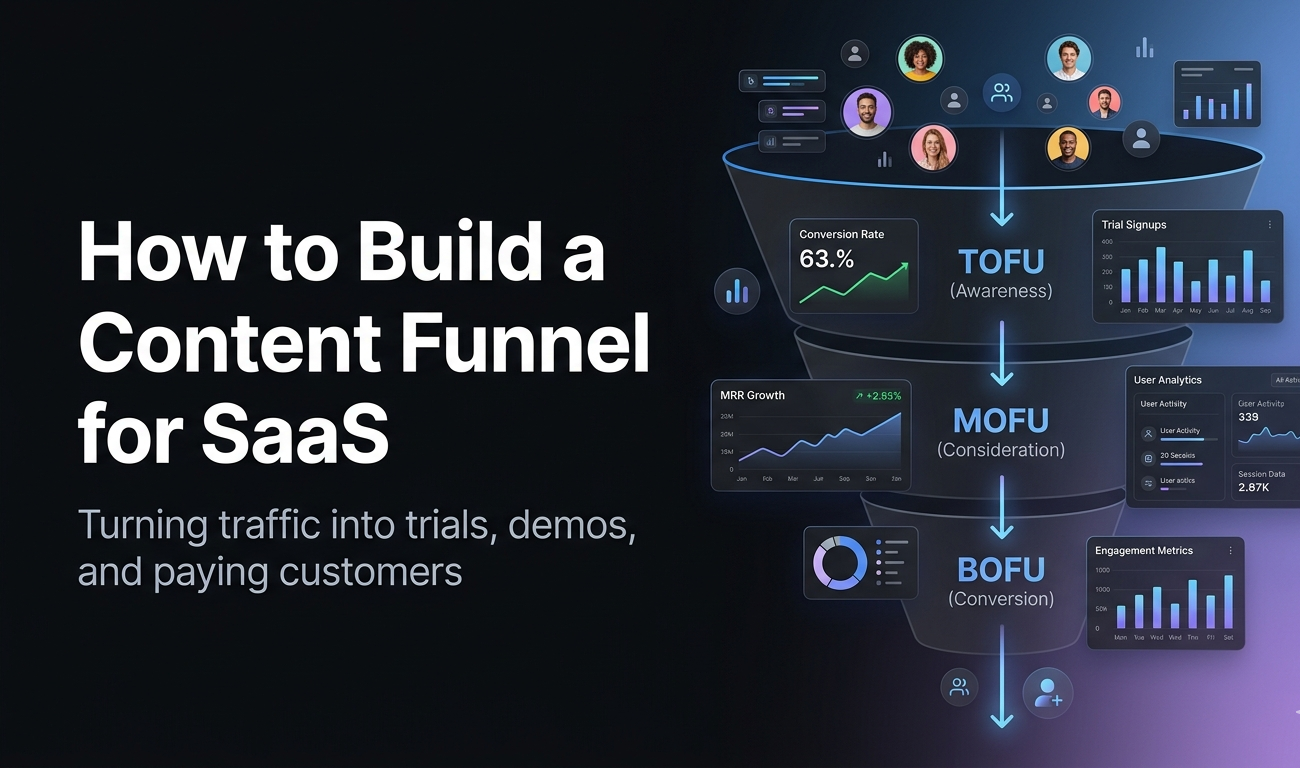
First, understand what you're actually building
Think about the last SaaS tool you paid for.
You probably didn't see one ad and instantly subscribe.
You searched for a problem. Read blogs. Compared tools. Watched videos. Checked reviews. Opened the pricing page three separate times because apparently everyone does that now.
Only then did you convert.
That entire journey is your content funnel.
And if your content only exists at one stage of that journey, you're leaking potential customers constantly.
Most SaaS brands create awareness content and then wonder why nobody buys.
Because awareness alone does not create trust.
Trust is built through repetition, clarity, and positioning.
This is exactly why having a proper brand positioning strategy matters before you start publishing random content.
The top of the funnel is not about your product
This is where most founders instantly ruin their own content.
Someone searches:
“how to reduce SaaS churn”
And the blog they land on starts with:
“At XYZ Software, we believe in innovation and customer success...”
Nobody cares.
At the top of the funnel, people are looking for answers, not products.
Your content here should educate, simplify, or challenge the way they think.
Not sell.
Examples of strong TOFU content:
- Why your onboarding flow is quietly killing retention
- Why most Indian SaaS startups struggle with activation rates
- How to reduce support tickets without hiring more people
Notice something?
None of these sound like sales pages.
Because TOFU content is supposed to build authority first.
The sale comes later.
This is where a strong content strategy separates brands that grow from brands that spam LinkedIn every day hoping for miracles.
The middle of the funnel is where real buyers appear
This is the stage most SaaS companies completely ignore.
Someone read your blog.
Cool.
Now what?
If your answer is “hopefully they book a demo,” your funnel is broken.
MOFU content exists for people who are actively evaluating solutions.
Now they want specifics.
Proof.
Numbers.
Confidence.
This is where content starts doing actual business work.
The content formats that work here:
- Case studies with real numbers
- Comparison blogs
- Product walkthroughs
- ROI calculators
- Email sequences
- Templates and downloadable resources
One brutally underrated SaaS asset is a proper case study.
Not vague testimonials.
Actual transformation.
Bad case study:
“Our client saw great results using our software.”
Good case study:
“How a Bangalore SaaS startup reduced onboarding time from 3 days to 4 hours.”
Specificity sells.
Generic claims don't.
The bottom of the funnel is where you remove fear
By this point, the buyer already knows who you are.
Now they're asking themselves questions like:
- Will this actually work for my company?
- Is this worth the money?
- What if onboarding is a nightmare?
- How hard is cancellation?
Your BOFU content exists to remove hesitation.
This means:
- A pricing page that makes sense
- Clear demo videos
- Transparent onboarding
- Competitor comparisons
- Testimonials that sound human
Here's something weirdly common in SaaS.
Companies spend months building features and three minutes writing the pricing page.
Then they wonder why conversion rates are terrible.
Your pricing page is not legal paperwork.
It's sales content.
Treat it like it matters.
Most SaaS blogs fail because they are isolated
One random blog ranking for one keyword is not a content strategy.
It's content gambling.
The smarter approach is building clusters.
You create one massive pillar guide around a core topic.
Then you create smaller blogs around related subtopics and internally link all of them together.
Example:
Pillar blog:
The Complete Guide to SaaS Onboarding
Supporting blogs:
- How to reduce user drop-off during onboarding
- Best onboarding email sequences for SaaS
- Why most onboarding tutorials fail
- How long should SaaS onboarding take?
Now Google starts viewing your site as an authority instead of just another startup blog screaming into the void.
And users stay on your website longer because every blog naturally leads them deeper into your ecosystem.
Which is the entire point.
Distribution matters more than most founders realise
You can write an incredible blog and still get no results if nobody sees it.
This is where distribution becomes the real growth engine.
And no, posting “new blog live” on LinkedIn is not distribution.
That's just announcing that you wrote something.
Real distribution means extracting insights from the blog and turning them into platform-native content.
Examples:
- A LinkedIn post around one strong insight
- A carousel breaking down one framework
- A short-form video summarising one key lesson
- An email newsletter expanding on one idea
The best SaaS brands don't just create content.
They repurpose intelligently.
This is where structured social media management becomes a compounding advantage instead of random posting.
Traffic is not the metric that matters
This part hurts some people's feelings, but it needs to be said.
High traffic means nothing if nobody converts.
A blog getting 300 qualified visits and converting at 5% is infinitely more valuable than a blog getting 10,000 random visitors who bounce instantly.
Vanity metrics make founders feel successful.
Revenue metrics build companies.
Track:
- Email signups
- Demo requests
- Free trial conversions
- Time on page
- Return visitors
- Sales-qualified leads
Not just pageviews.
A simple SaaS content funnel you can start this month
If your SaaS content strategy currently looks like chaos with a Canva subscription, here's a practical way to start fixing it.
Month 1
- Define your exact audience
- Publish 4 awareness blogs
- Set up email capture
- Optimise your internal linking
Month 2
- Create one pillar blog
- Write 3 supporting cluster blogs
- Publish one case study
- Start a nurture email sequence
Month 3
- Improve BOFU pages
- Create demo-focused content
- Build comparison pages
- Double down on highest-converting content
Simple.
Not easy.
But simple.
The real reason content funnels work
Because people don't buy software instantly.
They buy familiarity.
The more consistently someone sees your insights, your frameworks, your thinking, and your positioning, the more trust compounds.
And trust is what converts cold traffic into revenue.
The SaaS brands dominating organic growth right now are not relying on luck.
They're building systems.
Content systems.
SEO systems.
Distribution systems.
Conversion systems.
And once those systems start compounding, paid ads stop being the only growth channel holding the company together.
Published by Socioryx. We help SaaS startups and D2C brands grow through SEO, content systems, social media, positioning, and conversion-focused marketing. Explore our services.
Written by
Socioryx
Content marketing insights from the Socioryx team.